
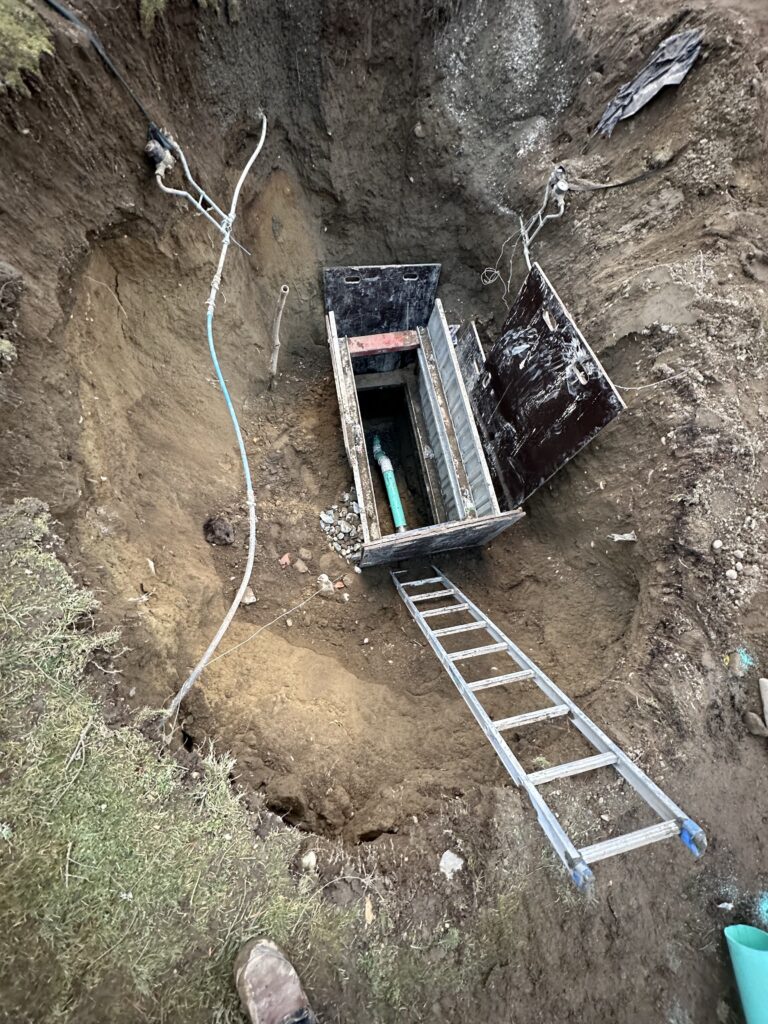
Orangeburg is a sewer pipe made of wood pulp and coal tar pitch. It went into a huge number of American homes from about 1945 into the early 1970s, it was expected to last around fifty years, and plenty of it is still in the ground in King County. If your house was built in that window and nobody has ever replaced the line out to the street, there’s a real chance you have it. And if you do, it’s already past its expected life.
What It Actually Is
The proper name is bituminous fiber pipe. The nickname comes from Orangeburg, New York, where one of the main manufacturers made it. Layers of wood fiber were wound into a tube and soaked in hot coal tar pitch until the whole thing hardened. The result looked a bit like a very thick roll of tar paper, and in a way that’s what it was.
It caught on after World War II for practical reasons. Cast iron was scarce and expensive, and the country was building houses as fast as it could. Orangeburg was cheap and light enough for one person to carry a length of it, and it could be cut with a handsaw. Builders put it in sewer laterals, drain lines and septic systems by the mile. By the early 1970s better plastic pipe had taken over and codes stopped allowing it.
How It Fails
Clay pipe cracks. Cast iron rusts. Orangeburg does something different: it slowly loses its shape. After decades of soil pressing down on it, the round pipe flattens into an oval, and in places the walls blister and peel apart in layers. The joints were tapered sleeves driven together, and they give roots an easy way in.
All of this happens slowly, which is the tricky part. A line can be getting worse for twenty years while it still drains well enough that nobody notices. Then one season the bore gets narrow enough that ordinary waste stops passing, and from then on it backs up regularly.
How to Tell If Your House Has It
There’s no way to know from inside the house. The drain pipes under your sinks and toilets tell you nothing about the line in the yard, and many homes of that era have cast iron inside the foundation that switches to Orangeburg a few feet outside it. These are the ways to actually find out:
- Start with the age of the house. Built somewhere between the late 1940s and the early 1970s, with the original side sewer still in place? Then Orangeburg is a live possibility. Built after the mid-1970s, and it almost certainly isn’t.
- Check the permit history. If the side sewer was replaced at some point, there’s usually a permit for it, and that settles the question. Inside Seattle, the city’s historical side sewer records often show what was installed and when. Other cities keep their own records, with varying levels of detail.
- Get a camera inspection. This is the only way to be sure. On camera, Orangeburg looks like nothing else: a dark, rough, slightly fuzzy wall, often with bubbles or flaking where the layers are separating, and a visibly oval shape where it’s started to deform. Clay is smooth and glazed. Cast iron is rusty brown and crusty.
If you ever have a section exposed, say during a landscaping project, Orangeburg is easy to recognize up close. It’s black, it feels like hard tar paper, and you can dent or scrape it with a pocketknife. You can’t do that to clay or cast iron.
The Symptoms That Usually Bring People to Us
Orangeburg tends to announce itself the same way other failing sewer lines do, which is part of why it goes undiagnosed. The pattern worth paying attention to is repetition. A line gets cleared, works for a few months, and backs up again in the same way. Each time, the plumber pulls out roots or paper, and each time the real cause stays in the ground.
Other signs include slow drains throughout the house at once, a toilet that gurgles when the washing machine drains, and a soggy or sunken strip in the lawn running roughly from the house toward the street. That last one can mean the pipe has collapsed enough to let sewage into the soil, or that soil is washing into the pipe and leaving a void above it.
Why Lining Usually Won’t Save It
Cured-in-place lining is a good repair for a lot of old sewer lines. A felt tube soaked in resin goes into the existing pipe, gets inflated against the walls and cures hard. You end up with a new jointless pipe inside the old one, and nobody has to dig a trench across the yard.
The trouble is that the old pipe has to act as the mold. It needs to be close enough to round, and solid enough to hold its shape while the liner cures. Deformed Orangeburg usually fails on both counts. Line an oval pipe and you get an oval liner with a smaller opening than you started with. Where a section has collapsed, there’s no pipe left to line at all.
There are early-stage cases where the pipe is still mostly round and lining is worth a hard look, and the camera footage is what tells us whether yours is one of them. For most Orangeburg, though, the realistic answer is replacement. Be wary of anyone who recommends lining an Orangeburg line without running a camera through it first.
What Replacement Looks Like
The usual method for Orangeburg is pipe bursting. We dig a small pit at each end of the line, one near the house and one near the connection to the main. A bursting head gets pulled through the old pipe, breaking it outward into the soil, and it drags a new length of high-density polyethylene pipe in behind it. Orangeburg breaks apart easily, which makes it one of the better candidates for bursting.
Because there are two pits instead of a trench, the lawn, the driveway and most of the landscaping come through intact. Trees usually do too, unless their roots have wrapped right around the old line.
Open trenching still has its place. If the line runs under part of the house, has collapsed so badly that a bursting head can’t get through, has sharp bends, or sits next to other utilities that can’t be disturbed, we dig. Which method fits your line depends on the camera footage and the site, so anyone quoting a firm price before seeing either is guessing.
One more thing. When one stretch of an Orangeburg line fails, the rest of it is exactly the same age and was made the same way. Patching the worst section and leaving the rest usually means paying for a second dig later. We’ll tell you if a partial repair makes sense on your line, but most of the time replacing the whole run is the better use of the money.
What to Ask Before You Sign Anything
A sewer replacement is one of the bigger checks a homeowner writes, so ask questions. These are the ones we’d want answered if it were our house.
- Can I see the camera footage? You should get to watch it, or get a copy, with someone pointing out where the problems are and how far from the house they sit.
- Which method are you proposing, and why that one for my line? A good answer points to something in the footage, like the shape of the pipe, how deep it runs, a bend, or what’s sitting on top of it.
- Does the price cover the connection at the main? Sometimes the work reaches into the street or the parking strip, and in Seattle that kind of right-of-way work needs its own street use permit on top of the side sewer permit. Find out who’s handling it.
- Will there be a cleanout when you’re done? If the line doesn’t have one now, the replacement is the cheapest time to add it.
- What happens to the pits afterward? Ask how the ground gets put back, and whether lawn, pavers or concrete are included in the price.
Get the answers in writing. When two quotes look wildly different, the gap is usually hiding in one of these.
Permits, and a Recent Change in Seattle
Replacing a side sewer needs a permit almost everywhere around here, and the plumber doing the work should be pulling it. Inside Seattle, side sewer permits and inspections moved from the Department of Construction and Inspections over to Seattle Public Utilities on October 1, 2025. A lot of the guidance you’ll find online still describes the old process, so don’t be surprised if what you read doesn’t match what happens. Kent, Renton, Auburn and the other cities in our area each run their own permit process.
If You’re Buying a House From That Era
Get a sewer scope before you close. A standard home inspection doesn’t include one, and once you own the house, the side sewer is yours to maintain all the way out to the main. A failing Orangeburg line is one of the bigger repair bills a new owner can inherit without knowing it. The time to find out is while you can still negotiate a repair or a credit, not the first winter after you move in.
We run sewer camera inspections across King and Pierce County, and we replace Orangeburg and other failed side sewers with trenchless methods wherever the line allows. You get the footage, and we’ll explain what it shows.
Or call 206-579-1757. More on trenchless sewer line replacement and sewer cleaning.
Questions We Get About Orangeburg Pipe
Does homeowners insurance cover Orangeburg pipe replacement?
Usually not. Most policies treat a sewer line that wore out with age as deterioration, which they exclude. Some insurers sell a separate service line endorsement that covers the lines running to your house, and a few home warranty plans include sewer lines with limits. Read the policy wording or ask your agent before you count on it.
How long does Orangeburg pipe last?
It was expected to last around fifty years. Some lines in well-drained soil have gone longer, and plenty failed well before that, especially where roots or heavy soil got to them. Anything installed in the 1950s or 1960s and still in the ground today is living on borrowed time.
Can you repair just part of an Orangeburg sewer line?
It can be done, and sometimes it makes sense, for example when a short section was damaged by a tree and the rest looks round on camera. Most of the time, though, the rest of the line is the same age and in similar shape, so a partial repair tends to mean another dig a few years later.
Is Orangeburg pipe still used today?
No. It was phased out by the early 1970s when PVC and ABS plastic pipe took over, and current plumbing codes don’t allow it. Any Orangeburg you find is original to the house or very close to it.
How long does pipe bursting take?
For a typical house-to-street side sewer, the work itself often takes a day or two. The permit and the inspection add time on either side, and how much depends on the city. Because there are two small pits rather than a long trench, cleanup afterward is quick.
Will replacing my sewer line damage my trees?
With pipe bursting, usually not. It needs two small pits instead of a trench along the whole line, so most root systems are left alone. The exception is a tree whose roots have grown tightly around the old pipe, and if that’s the case, the camera usually shows it before we start.