
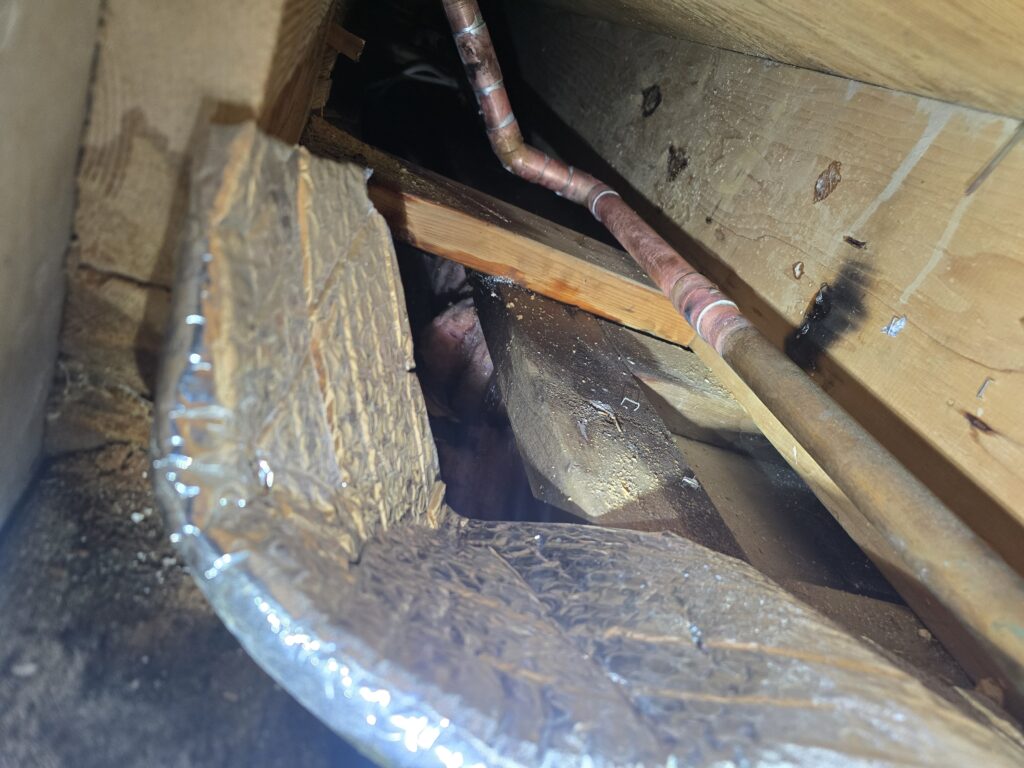
Standing water in a crawl space comes from one of three places. It’s either groundwater coming up from below, rainwater draining toward the house from outside, or a plumbing leak somewhere under the floor. Once there’s an inch of water down there they all look the same, but each one has a different fix. Figuring out which you have is most of the job, and you can usually narrow it down yourself before anyone comes out.
Why This Is Such a Northwest Problem
Most of what’s written about water under a house assumes the house has a basement. Most homes around here don’t. Research on building practice in Washington found that vented crawl spaces dominate construction in the western part of the state, and anyone who has crawled under a few Kent or Auburn houses could have told you the same thing.
A crawl space behaves differently from a basement in ways that matter here. It’s shallow, so it can end up sitting right at the level of the groundwater in a wet winter. It’s vented to the outside, so the air down there is as damp as the air outdoors. And hardly anybody ever goes in. A basement leak gets noticed within a day. A crawl space leak can run all season before somebody wonders why the house smells musty.
Start With Timing
The quickest way to sort out the source is to ask when the water shows up.
It Comes With Heavy Rain and Leaves Slowly: Groundwater
Groundwater shows up during and after a long wet stretch, and it seeps up through the dirt floor or in along the base of the foundation wall rather than dripping from above. It tends to spread evenly across the lowest part of the crawl space and drain away slowly, over days, once the rain lets up.
This is the most common source on the valley floor. A lot of homes in Kent, Auburn and Tukwila sit on a high water table in the Green River valley, and in a wet January the water table can rise right up to the crawl space floor.
It Comes During the Storm and Enters at One Spot: Surface Water
Surface water is driven by rain too, but it arrives faster and usually comes in at one identifiable place. Look for a channel worn in the dirt, or a fan-shaped smear of silt, pointing back toward where it got in. Usually it’s below a downspout that empties right next to the foundation, or under a part of the yard that slopes toward the house.
This one is often fixable from above ground. A downspout extension or some regrading costs far less than anything involving a pump.
It Shows Up in Dry Weather: A Plumbing Leak
If there’s water down there in August, it isn’t groundwater. Plumbing leaks don’t care about the weather. Look for a wet area right under a bathroom, the kitchen or the laundry, and water that’s clean rather than muddy. A leak on a supply line runs all the time. A leak on a drain only shows up when someone uses the fixture above it.
Rule this one out first, because it’s the only one of the three that costs you money every single day and won’t get better when the weather turns dry.
The Water Meter Test
You can check for a supply leak without going under the house at all. Turn off every tap, make sure the dishwasher, washing machine and ice maker aren’t running, and go look at your water meter. Most meters have a small dial or triangle called a leak indicator that spins when any water is moving through it.
If that indicator is turning with everything in the house switched off, water is going somewhere. Write down the full reading, wait an hour without using any water, and check again. If the number has moved, you have a leak, and if the crawl space is wet, there’s a good chance you’ve found where it’s going.
What to Do This Week
- Take photos of the water from the hatch, and note how high it reaches against the foundation or the piers. That mark tells you how bad it gets, and it’s useful for anyone you call in.
- Walk the outside of the house in the rain. Watch where every downspout empties, and look for spots where water pools against the foundation.
- Do the meter test above.
- Stay out of standing water if there’s any wiring, a furnace or a pump down there. Water and electricity in a confined space is a bad combination, so get the power checked before anyone climbs in.
When a Sump Pump Is the Right Answer
A sump pump is for water that’s already getting in and has no way to drain out on its own. That’s real groundwater intrusion: a water table that rises above the crawl space floor every wet season, with no slope that lets gravity carry the water away. In that situation the fix is a pump in a lined pit at the lowest point of the crawl space, sized for how fast the water comes in, with a discharge line that carries it well clear of the foundation.
It’s the wrong first move when the water is coming from a downspout emptying against the wall. A pump there handles the symptom and leaves the cause running. If an extension and a bit of regrading will solve it, that’s what we’ll tell you, even though the pump would be the bigger job for us.
A perimeter drain, sometimes called a footing drain, sits somewhere in the middle. It catches water before it reaches the crawl space and carries it off by gravity. On a sloped lot that can work with no pump at all. On a flat lot down in the valley, the drain usually still needs a sump at its low point to send the water somewhere.
Check the Downspout Lines Before Anything Else
On a lot of older houses around here, the downspouts don’t just empty onto a splash block. They run into a buried pipe, sometimes called a tightline, that’s supposed to carry roof water away to the street or a dry well. After forty or fifty years those pipes are often crushed, full of roots, or packed solid with silt and moss washed down from the gutters. When that happens, all the rain off your roof gets dumped into the soil right at the foundation, and a good share of it ends up under the house.
It’s easy to check. During a decent rain, look at where each downspout goes into the ground. If water is spilling back out of the top of the pipe, or the ground around it is soaked while the rest of the yard is fine, that line is blocked. Disconnect the downspout and run a temporary extension several feet out into the yard, and you’ll know quickly whether that was the cause.
What a Crawl Space Sump Install Involves
If it does turn out to be groundwater, here’s what the work looks like. We find the lowest point in the crawl space, which isn’t always where you’d guess, and dig a pit there. A perforated liner goes in, surrounded by gravel, so groundwater can get in while most of the silt stays out. The pump sits inside the liner with a check valve on its discharge, and the discharge pipe runs out through the foundation or the rim joist to a spot well away from the house where your city allows it to drain.
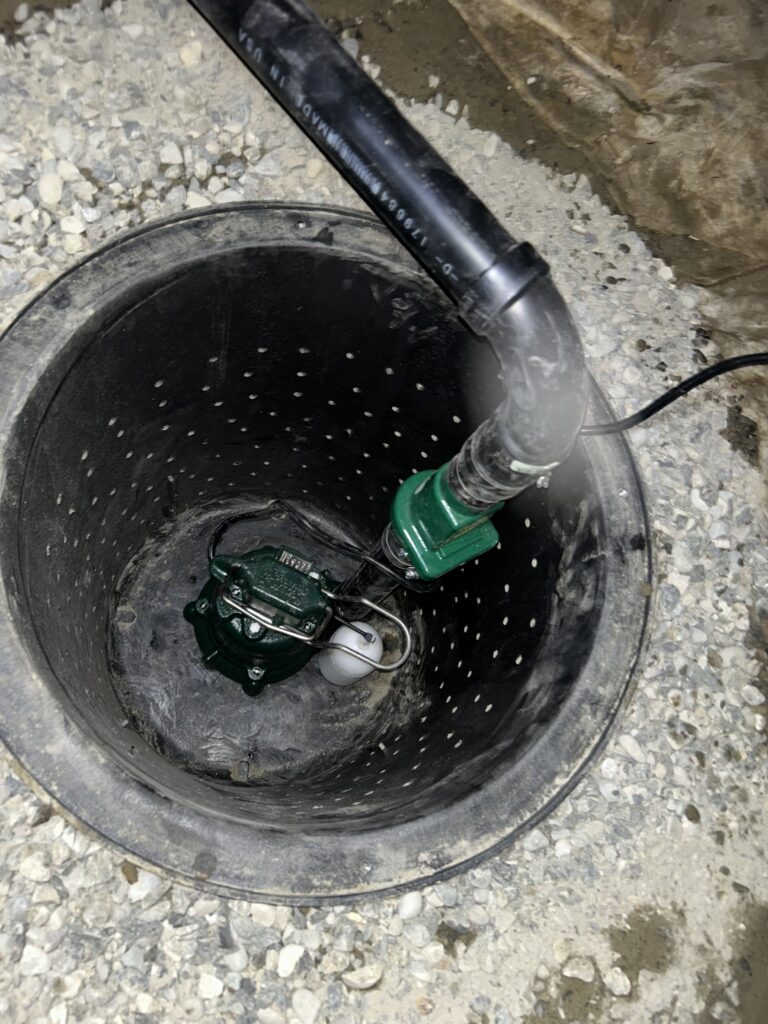
The pump needs its own GFCI outlet, ideally on a circuit it doesn’t share with anything else. We’d also strongly suggest a high-water alarm. Nobody checks on a crawl space pump, and an alarm is how you find out it has stopped before the water tells you.
A Vapor Barrier Won’t Stop Flooding
The plastic sheeting on a crawl space floor is a vapor barrier. Its job is to stop moisture in the soil from evaporating up into the house. It isn’t designed to hold back liquid water, and it won’t.
In a crawl space that actually floods, a vapor barrier can make things worse. Water gets trapped on top of the plastic where it can’t soak back into the ground or dry out, and that’s a reliable way to grow mold on the underside of your floor. Sort out the water first and deal with the barrier after. Encapsulation, which means sealing the crawl space and conditioning the air in it, is a worthwhile project, but it belongs at the end of the list.
Why You Shouldn’t Leave It Until Spring
Water under a house doesn’t stay a water problem for long. It pushes humidity up, so moisture condenses on the underside of the subfloor. The insulation between the joists soaks up water and sags out of place, and wet insulation doesn’t insulate anything. Give it a few seasons and you start to see rot in the sill plates and the ends of the joists, and structural repair costs many times what drainage does.
It also makes the crawl space miserable to work in, and every trade that ever needs to get at your pipes or wiring has to deal with it.
Early fall is the best time to look at all this. The ground is still dry enough that you can see where water came in last winter, since the silt lines and stains are still there, and there’s time to fix it before the rain comes back.
If you’d rather not crawl under there yourself, we will. We look at crawl space water across King and Pierce County, work out which of the three sources you’re dealing with, and tell you plainly if the answer is a downspout rather than a pump.
Or request a callback. More on crawl space sump pumps and water line repair.
Questions We Get About Crawl Space Water
Is some moisture in a crawl space normal?
In the Northwest, some dampness is normal. The soil smells earthy and the air is humid, and in winter you may see a little condensation on cold pipes. Standing water isn’t normal, and neither is a vapor barrier with puddles sitting on top of it or insulation sagging down from the joists.
Should I close my crawl space vents in winter?
Closing them before a hard freeze helps protect any pipes running through the crawl space, so it’s a good idea when a cold snap is forecast. Open them again afterward. Sealing a vented crawl space shut for good, without conditioning the air in it, tends to trap moisture and cause the problems you were trying to avoid.
Does homeowners insurance cover crawl space flooding?
It depends on where the water came from. Groundwater and surface flooding are usually excluded from a standard policy, while sudden damage from a burst pipe is often covered. Slow leaks that ran for months are where claims tend to get denied. Check your policy, and take photos and notes the day you find the water.
How can I tell if the water is from a plumbing leak?
If the water is there in dry weather, look at plumbing first. Turn off every tap and appliance and watch the small leak indicator on your water meter. If it moves, water is going somewhere. Clean water sitting under a bathroom or kitchen also points to a leak rather than groundwater, which is usually muddy.
Can I pump the water out myself?
For a small amount, a rented utility pump works, as long as there’s no wiring, furnace or equipment sitting in the water. Check the power situation before anyone goes in. Pumping it out doesn’t fix anything, though. If it keeps coming back, you need to find out why.
Does a crawl space sump pump need its own pit?
Yes. The pump sits in a lined pit dug at the lowest point of the crawl space, so water drains toward it. The liner keeps silt out of the pump, and the discharge line has to carry the water well away from the foundation. A pump just set down in a puddle on the dirt doesn’t last long.