
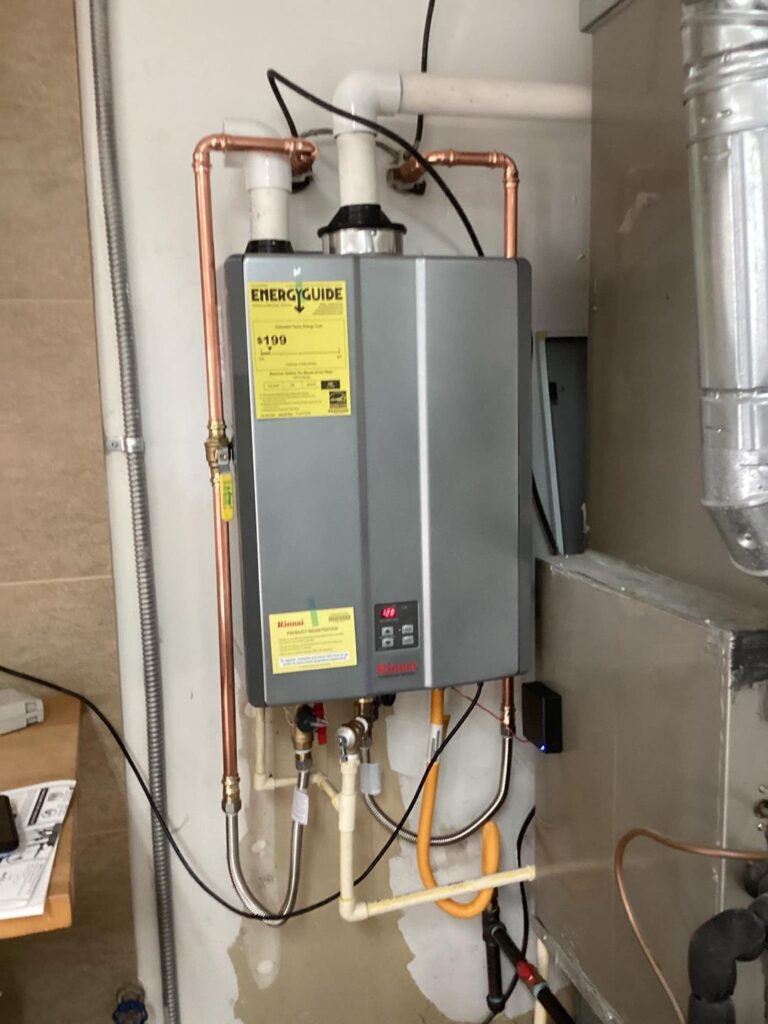
Less often than most of what you’ll read online, if you’re on city water. A lot of the descaling advice out there is written for places like Phoenix and San Antonio, where the water is hard enough to scale up a tankless heater within a year. Seattle’s supply and Kent’s are both soft. On water like that, descaling a tankless unit every year or two is usually plenty. Homes on a private well are the exception, and well water is where we see tankless heaters really struggle with scale.
Find Out What’s in Your Water First
You don’t have to guess. Every public water utility publishes an annual water quality report, sometimes called a Consumer Confidence Report, and hardness is usually listed in it. You’ll see it in parts per million or grains per gallon. One grain per gallon is about 17 ppm.
As a rough guide, under 60 ppm is soft, 60 to 120 is moderately hard, and anything above that is hard. Kent’s reported figures sit comfortably in the soft range, and Seattle’s water is soft as well. If you’re on one of those systems, scale builds slowly in a tankless heater.
On a private well there’s no report to look up, so get the water tested. Plenty of rural properties out around Maple Valley and Enumclaw are on wells, and well water around here can vary a lot from one lot to the next. Some of it is perfectly soft. Some will crust up a shower head in a few months. A hardness test doesn’t cost much and it’s the only way to know what you’re working with.
What Scale Does Inside a Tankless Unit
A tank heater warms forty or fifty gallons slowly and keeps it hot. A tankless heater only heats water when you open a tap, which means pushing it through a narrow heat exchanger and hitting it with a lot of heat over a very short stretch of pipe. That’s what makes it efficient. It’s also what makes it fussy about minerals.
Calcium and magnesium come out of solution when water is heated hard and fast, and they stick to the inside of the exchanger. A thin layer insulates the water from the burner, so the unit fires harder and longer to reach the same temperature. A thicker layer narrows the passages and cuts the flow. Eventually you get error codes, temperature swings, or a heater that shuts itself off halfway through a shower.
The heat exchanger is the most expensive part in the box. Replacing one can cost a good share of what a whole new unit costs, which is why scale is worth staying ahead of even when it builds slowly.
What Speeds It Up, Even on Soft Water
A few habits make scale build faster no matter what your water report says. The biggest one is temperature. Minerals come out of solution much faster once water goes above about 140°F, so a unit set higher than it needs to be scales up quicker than one set at 120. For most households, 120 is plenty for showers and dishes.
Recirculation is the other one. If your tankless heater runs a recirculation pump so hot water gets to the far bathroom faster, the unit fires far more often than it otherwise would, and every firing leaves a little more behind. Heavy use works the same way. A family of six taking back-to-back showers puts more water through the exchanger in a month than a couple does in a season, and the service schedule should reflect that.
Signs You’re Overdue
- Hot water takes longer to arrive than it used to. The change is gradual, so most people only notice it when they think back to how it was.
- The temperature drifts during a shower, especially when someone turns on another tap.
- Flow on the hot side has dropped while the cold side still runs strong.
- The unit cycles on and off during a steady draw instead of running continuously.
- An error code. Rinnai units, for example, show an LC code when they detect scale building up. Your manual lists the equivalent for your brand.
On soft city water, these symptoms usually turn out to be a clogged inlet filter rather than scale. There’s more on that below, and it’s a much easier fix.
Descaling It Yourself
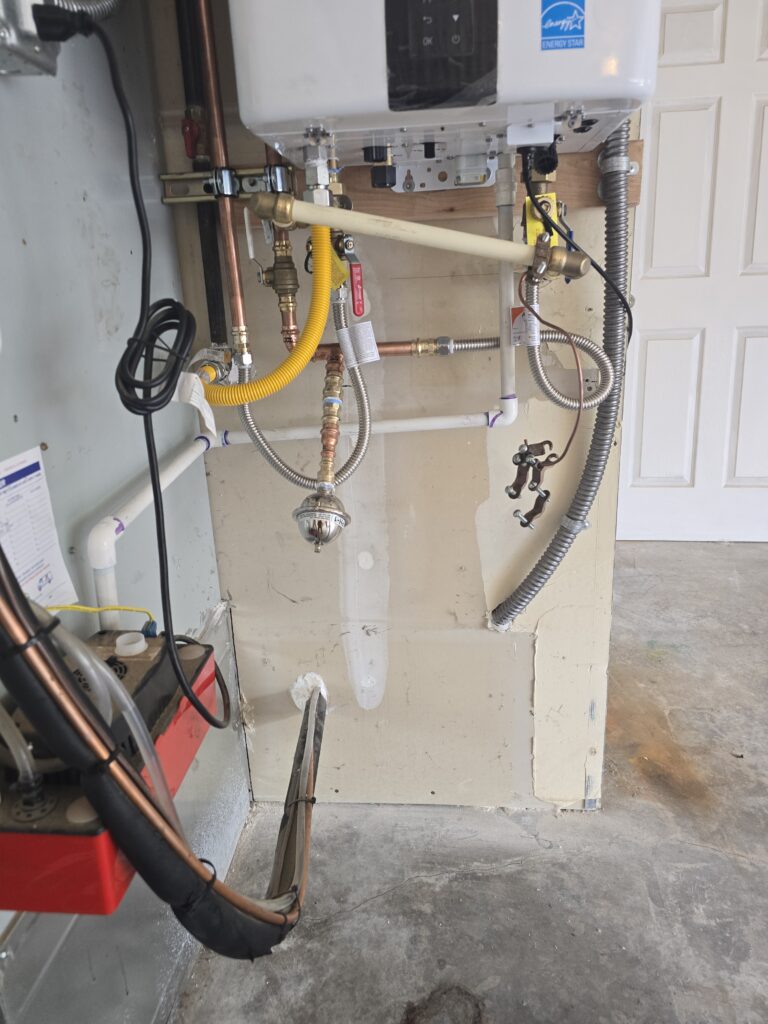
If your installer put in isolation valves, you can do this yourself. They’re the two service valves under the heater, one on the cold line and one on the hot, each with a small hose port next to it. If you’ve got them, the job goes like this:
- Turn off the gas and the power to the heater.
- Close both isolation valves.
- Connect a small submersible pump and hose to the cold-side port, and run a second hose from the hot-side port back into a bucket.
- Put a few gallons of white vinegar or a descaler made for tankless heaters in the bucket with the pump.
- Open the service ports and run the pump for 45 minutes to an hour so the solution circulates through the exchanger.
- Dump the bucket, run clean water through for a few minutes to rinse, close the ports, open the isolation valves and turn the unit back on.
Read your manual before you start. Some manufacturers specify their own descaling product or interval, and a few tie the heat exchanger warranty to documented maintenance. If yours is still under warranty, a service record from a plumber is easier to produce than a receipt for vinegar.
No isolation valves? Then it isn’t a do-it-yourself job, because fitting them means cutting into the water lines under the heater. We’d suggest having them put in regardless. Every service after that is quicker and cheaper.
The Part Most People Forget: The Inlet Filter
Most tankless units have a small mesh screen where the cold water comes in. It catches grit before it can reach the heat exchanger. On soft water, that screen causes trouble more often than scale does. It gets worst after nearby water main work or hydrant flushing, when sediment that’s been sitting in the pipes gets stirred up and pushed into houses.
A partly clogged screen cuts flow and makes the heater act up in ways that look a lot like scaling. Pulling it out, rinsing it and putting it back takes a few minutes. It’s the first thing we check when someone calls about weak hot water from a tankless unit.
What Else a Service Visit Covers
Descaling only deals with the water side. A gas tankless heater also has a combustion side, and that needs its own look. We check the burner and the flame sensor, the air intake, and the venting for blockages or loose joints. On a condensing model we check the condensate line and the neutralizer, because a clogged condensate drain will shut the unit down on its own.
We also check gas pressure while the heater is running flat out. A tankless unit pulls a lot of gas when it fires, and an undersized gas line causes symptoms that look a lot like a scaled-up exchanger. We’d rather rule that out before anybody starts talking about a new heater.
When to Book It
Late spring and summer are the easiest times. Nobody minds a couple of hours without hot water in July, and you’re not trying to schedule around a cold snap. If you can’t remember when the unit was last serviced, assume it hasn’t been.
We service and install tankless water heaters across King and Pierce County, and we can add isolation valves to units that went in without them.
Rather talk it through first? Call 206-579-1757. More on tankless water heaters and water heater repair.
Questions We Get About Tankless Water Heater Maintenance
How do I find out if my water is hard or soft?
If you’re on city water, look up your utility’s annual water quality report, often called a Consumer Confidence Report. Hardness is usually listed in parts per million or grains per gallon. Under about 60 ppm is soft. If you’re on a private well, get the water tested. Test strips give you a rough idea, and a lab test gives you a real number.
Do I need a water softener for a tankless water heater?
On city water in Seattle or Kent, almost certainly not. The water is already soft. On a hard private well it can make sense, and some manufacturers recommend treatment once hardness passes a certain level. Check your heater’s manual for the number before you buy anything.
Can I use vinegar to descale a tankless water heater?
Yes. Plain white vinegar works, it just works a bit slower than a commercial descaler. Circulate it for 45 minutes to an hour and rinse with clean water afterward. Some manufacturers name a specific product in the manual, and if your unit is under warranty, use what they say.
How long does it take to descale a tankless heater?
About an hour of circulating the solution, plus setup and rinsing, so call it an hour and a half to two hours start to finish. You won’t have hot water during that time. If the unit needs isolation valves fitted first, add time for that.
What happens if I never descale my tankless water heater?
On soft city water, possibly nothing dramatic for years. On hard well water, scale builds up in the heat exchanger, cuts flow and makes the burner work harder, and in the end it can kill the exchanger. Whatever your water is like, the inlet filter still clogs, so that should get cleaned regardless.
Does a tankless water heater need any other maintenance?
Yes. The inlet filter screen needs cleaning, the air intake and venting should be checked for blockages, and on a condensing unit the condensate line and neutralizer need attention. A clogged condensate drain will shut the heater down. Most of this gets covered in a single service visit.