
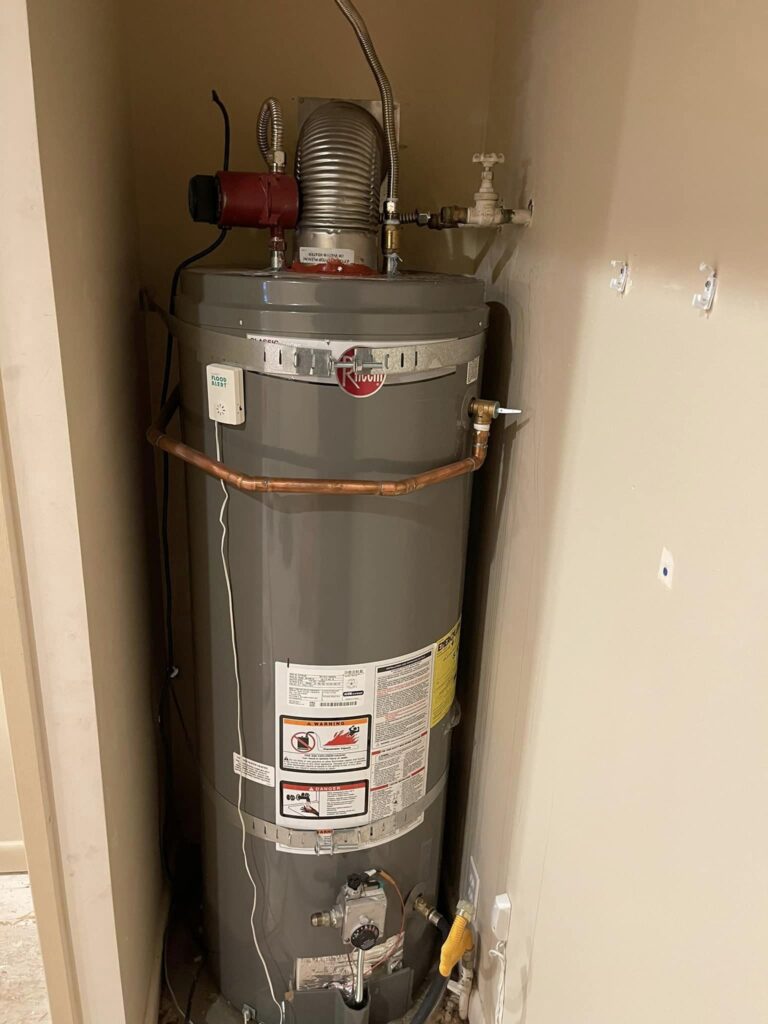
There’s a puddle under your water heater and you want to know whether this is a cheap fix or a new tank. Fair question. Here’s the short version: water coming out of the bottom of the tank itself means the tank is done, and no plumber can patch it. But three other things leak in roughly the same spot, and all three are repairable. So before you start pricing replacements, spend ten minutes working out which one you’ve actually got.
Dry the Floor and Wait an Hour
This is the single most useful thing you can do before anyone shows up. Mop up every bit of standing water, slide a few sheets of paper towel under and around the base of the heater, and leave it alone for an hour.
Water runs downhill. A drip from a fitting at the top of the tank will trickle down the outside of the jacket and collect at the floor, which looks identical to a tank that’s rusted through. Paper towel tells you where the water is landing first. If the towel nearest the drain valve is soaked and everything else is bone dry, you’ve just saved yourself a lot of guessing.
While you’re down there, take a photo of the rating plate on the side of the tank. It has the model and serial number, and the serial usually encodes the build date. That date decides whether you’re inside a warranty.
The Four Things That Leak
The Drain Valve
That’s the spigot near the floor, the one that looks like a hose bib. It’s there so the tank can be flushed. On most residential heaters the internals are plastic, and plastic washers give up years before the steel tank does.
If the valve body is wet but the floor directly under the tank is dry, this is almost certainly your leak. Sometimes it’s just loose. Sometimes the washer is shot and the whole valve gets swapped for a brass one, which is what we fit as a matter of course because the brass ones don’t do this. Either way it’s a small job.
The T&P Valve
The temperature and pressure relief valve sits near the top, with a discharge pipe running down the side of the tank and stopping a few inches off the floor. If water is coming out of the bottom of that pipe, the valve is doing exactly what it was designed to do. It’s dumping pressure.
So something upstream needs attention. Maybe the thermostat is set too high and the water is expanding more than the tank can absorb. Maybe your incoming pressure is running above what the heater is rated for. The one we find most often, though, is a house with a pressure reducing valve on the main and no thermal expansion tank. Heated water has nowhere to expand into, so pressure climbs every time the burner fires.
Somebody fits a PRV, nobody adds the expansion tank, and the heater takes the blame for years.
Whatever you do, don’t cap that pipe or plug the valve. We have watched people try it to stop the dripping. That valve is the only thing standing between a pressurised tank and a very bad afternoon.
The Inlet and Outlet Connections
Two pipes come into the top of the heater, cold in and hot out. The threaded joints there can weep, especially where copper meets the steel nipple on the tank. Two dissimilar metals in contact with water corrode at the join. Dielectric unions exist to stop that, and in plenty of older Kent and Auburn homes they were never fitted at all.
A leak here drips down the jacket and pools at the base. Looks like a dead tank. Isn’t one. Pull the top access panel off and you’ll usually see the green or white crust of corrosion right at the fitting.
The Tank
Connections dry. Valves dry. Water appearing from underneath the unit with no trail down the side. That’s the tank.
Inside the steel shell there’s a thin layer of glass enamel doing all the corrosion protection, plus a sacrificial anode rod that’s meant to corrode instead of the steel. The anode gets consumed over six to ten years. Once it’s gone, the enamel takes the punishment, enamel cracks with thermal cycling, and then water gets at bare steel. It rusts from the inside out, and by the time it shows up on your floor there’s nothing left to work with.
You can’t repair a tank. We get asked about welding it and about the epoxy products the hardware store sells for exactly this, and the answer is no both times. It gets replaced.
What the Noise Is Telling You
If your heater has started sounding like someone shaking a jar of gravel, that’s sediment.
Sediment settles on the bottom of the tank. Some of it is minerals and some is fine grit that comes in with the water supply. In a gas heater the burner is directly underneath, so water gets trapped in that sediment layer, superheats, and flashes to steam. The popping is steam bubbles forcing their way up through the sludge.
On its own it isn’t dangerous. It matters for two other reasons though. Sediment insulates the burner from the water it’s supposed to be heating, so the burner runs longer for the same result and your gas bill creeps up without you noticing. And that superheated layer is hard on the enamel lining, which brings forward the day the tank fails.
A heater that’s started popping has gone a long time without a flush. One that pops and leaks at the base is usually telling you the same thing twice.
First Ten Minutes, in Order
- Shut the water off to the heater. There’s a valve on the cold inlet at the top. Clockwise until it stops. If it’s seized solid, which happens on valves nobody has touched in fifteen years, go shut off the main for the house instead.
- Kill the heat. Gas heater, turn the control dial to OFF. Electric, switch off its breaker. An element firing in a tank that’s draining will burn out in seconds, and a gas burner has no business running under a leaking tank.
- Leave it full for now, unless water is heading for finished flooring or anything you care about. There’s more information in a tank that hasn’t been drained, and we’d rather see it as it is.
- Get things off the floor and put a towel line between the puddle and the nearest carpet or drywall.
- Don’t relight the pilot. If it went out on its own, leave it out until someone has looked at why.
Then call. If you smell gas at any point, skip all of the above, get everyone out, and ring the gas utility from outside before you call a plumber.
Eight to Twelve Years, Depending on Where It Lives
Manufacturers put a standard tank heater at eight to twelve years. Where yours lands in that range has less to do with the brand than with two local details.
The first is your water. Seattle’s supply and Kent’s are both soft, which is easy on a tank. Homes on a private well are a different story. Well water in rural King and Pierce County can be a lot harder, and a tank on hard water that never gets flushed fills with scale years ahead of schedule.
The second is where the heater lives. In this area a huge number of heaters sit in an unheated garage or a vented crawl space. Cold ambient air all winter means the burner cycles more often to hold temperature, and more cycles means more expansion and contraction on that enamel lining. A heater in a warm utility closet has an easier life than the same model bolted to a crawl space wall in Renton.
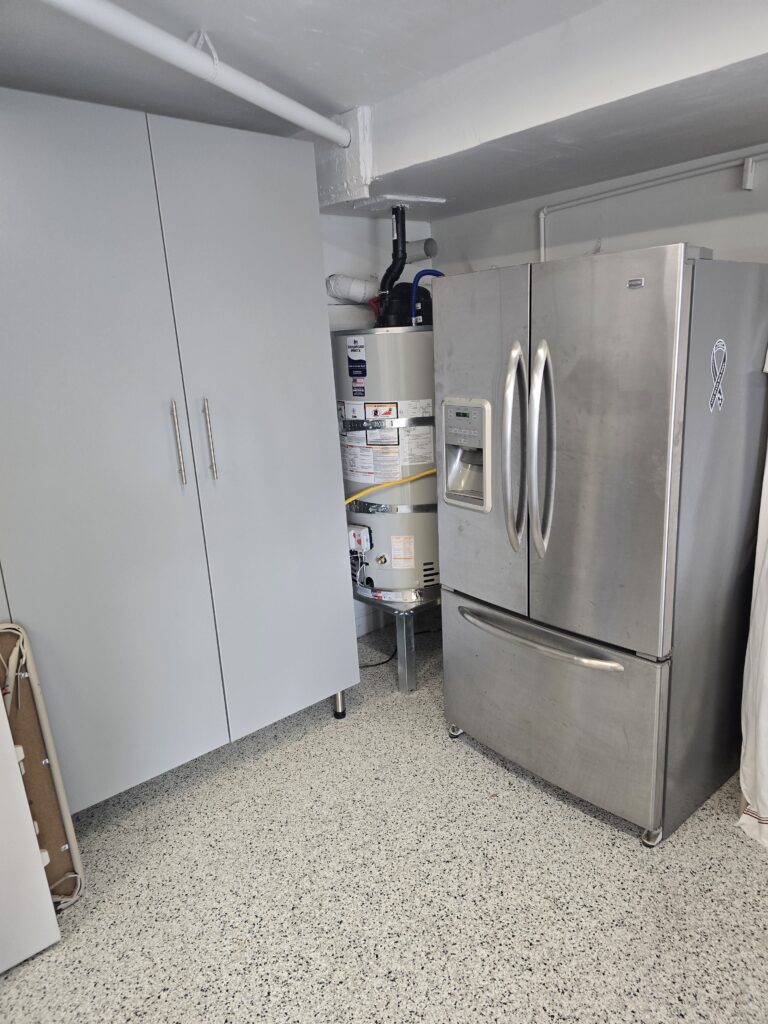
Here’s how we’d call it. If the unit is past ten years and it’s leaking anywhere at all, even from a repairable fitting, replacement is usually the better money. You’d otherwise be paying a service call on an appliance that doesn’t have much runway left, and you’ll likely be paying another one inside two years.
Under about seven years, fix the fitting. In between, it depends on what we find when we take the panels off.
Call Today If Any of This Is True
Water reaching drywall, flooring, or anything stored nearby. Gas smell anywhere near the unit. The T&P pipe discharging continuously rather than occasionally. A tank that’s visibly bulging or has rust streaking down from a seam. Those aren’t Monday problems.
We handle water heater repair and replacement across King and Pierce County, same day in most of our area, and we’ll tell you straight whether yours is worth fixing. If it turns out you need a new one and the old tank is crammed into a crawl space, ask about going tankless while the access is open. They don’t fail the way a corroded tank does, and you get the floor space back.
Or request a callback and we’ll get back to you. More on water heater service and tankless options.
Questions We Get About Leaking Water Heaters
Is a little water under a gas water heater ever normal?
Sometimes. When a gas heater fills with very cold water, condensation can form on the inside of the flue and drip onto the burner, and you’ll hear it hiss. You see it most with a brand new heater, or after a long run of hot water on a cold morning. It should stop once the tank is back up to temperature. If water keeps showing up after the tank has been hot for a few hours, it isn’t condensation.
Can I keep using a water heater that’s leaking?
If it’s the drain valve or a fitting and the drip is slow, you can usually get by for a day or two with a pan under it while you book the repair. If the tank itself is leaking, turn it off and leave it off. A rusted-through tank can go from a seep to a flood with no warning, and it won’t pick a convenient time to do it.
Is a leaking water heater dangerous?
The water itself is mostly a damage problem. It soaks into subfloor and wicks up drywall, and that gets expensive if it sits. The two things that actually worry us are a gas smell near the unit and a relief valve that won’t stop discharging. Either one means shut the heater off and get someone out today.
Does homeowners insurance cover a leaking water heater?
Usually it covers the water damage but not the heater. Most policies treat a worn-out tank as wear and tear, so the replacement is on you, while sudden damage to floors and walls is often covered. Claims tend to get denied when a slow leak ran for months and nobody dealt with it. Your policy wording decides this, so check it or ask your agent.
How long does a water heater replacement take?
A straight swap, same fuel and a similar size in the same spot, is usually a few hours. It runs longer if the venting needs work or you’re moving to tankless. Crawl space installs behind a small hatch add time too, mostly getting the old tank out. Most cities around here require a permit to replace a water heater, and the plumber doing the work should be pulling it.
How often should I flush my water heater?
Once a year is what most manuals say. On soft city water you can usually stretch that a bit, but on a private well, stick to yearly. If you’ve never flushed yours and the tank is more than five or six years old, go carefully. A drain valve that hasn’t been opened in years sometimes won’t seal again afterward, and a heavy sediment load can clog it halfway through. That first flush is a good one to have us do.